
Experts: Board Effectiveness Begins with the Quality of Its Members; Reaching the First Customer Is a Key Challenge for Entrepreneurs in the Technology Sector
The 2026 Women’s Economic Forum featured discussions in its dialogue sessions and accompanying events on the future of women’s leadership, the role of innovation and artificial intelligence in developing the business environment, and the advancement of entrepreneurship and economic sustainability. The discussions brought together distinguished leaders, experts and specialists in management, business, technology and scientific research.
Quality Decisions Are the Foundation of Effective Leadership
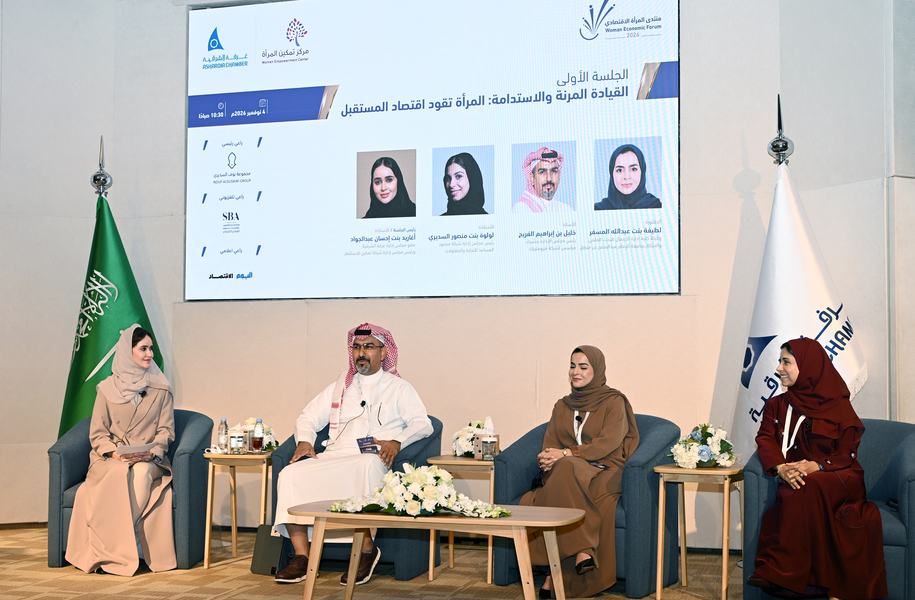
As part of the forum, the first session, titled “Agile Leadership and Sustainability: Women Leading the Economy of the Future,” was held with the participation of Dr. Latifa bint Abdullah Al-Musfer, Vice Dean for Scientific Research and Innovation at the College of Business Administration, Imam Abdulrahman bin Faisal University; Khalil bin Ibrahim Al-Furaih, Chairman of the Board and Co-Founder of Humetric; and Lulu bint Mansour Al-Sudairi, Chairwoman of the Board of Mansour Al-Musaid Trading and Contracting Company. The session was moderated by Agharid bint Ihsan Abduljawad, Asharqia Chamber Board Member and Chairwoman of the Board of Tamkeen Investment Company.
The session discussed women’s role in leading economic transformations, advancing sustainability and envisioning the future of business amid rapid change. It also addressed the importance of using artificial intelligence technologies to develop the business environment, support scientific research and innovation, and connect their outcomes with the industrial sector, thereby enhancing competitiveness and creating new economic opportunities.
Participants emphasized the importance of integrating knowledge, technology and industry to build a sustainable economy capable of keeping pace with future changes. They noted that achieving this requires greater investment in scientific research and the transformation of innovations into practical applications with economic value. The session also explored the concept of agile leadership and what it entails: allowing decisions sufficient time to mature, and being able to reassess and review them whenever changing circumstances require, without clinging to previous choices. This, in turn, enhances decision quality and improves institutional performance.
Speakers stressed that effective leadership is not limited to making decisions; it also involves assessing their outcomes, being prepared to develop them or reconsider them, and drawing on diverse expertise and perspectives to address challenges and turn them into opportunities.
On governance and management, the session affirmed that the true value of an effective board of directors is not simply a matter of its formation or the number of its members. Rather, it lies in the quality of its members, the breadth of their experience, knowledge and perspectives, and their ability to help shape strategic direction and make decisions that support organizations’ sustainability and growth. The session concluded by emphasizing that agile leadership is a fundamental pillar of the economy of the future, as women’s role grows in leading organizations, advancing innovation and actively contributing to economic transformations.
From Innovation to Economic Value
In the second session, titled “Future Horizons: Innovation and Artificial Intelligence in Empowering Entrepreneurship,” participants discussed the role of innovation and modern technologies in supporting entrepreneurial ventures and explored the main opportunities and challenges facing technology products as they enter the market and generate economic value.
The session was moderated by Manal bint Abdulrahman Al-Bawardi, Chief Information Technology Officer at King Fahd University of Petroleum and Minerals. Participants included Dina bint Saad Al-Dubai’an, Director of Revenue Control and Regulation at the Business Development Sector of the Saudi Data and Artificial Intelligence Authority (SDAIA); Dr. Sarah bint Omar Al-Hamoud, Co-Founder and Chief AI Officer at Wittfy.ai; Luay bin Saleh Labni, Founder and CEO of InnoSoft; and Maram bint Abdulaziz Al-Jishi, Senior Partner Solutions Sales Manager for Cloud and AI at Microsoft Arabia.
The session highlighted the support that the innovation and entrepreneurship sector receives from the wise leadership, including the creation of an environment that fosters innovation and support for technology products, enabling them to move from development to commercial application. This enhances growth opportunities for startups and helps expand their economic impact.
Speakers affirmed that reaching the first customer is one of the most significant challenges facing entrepreneurs in the technology sector. It is a pivotal step in demonstrating a product’s viability, verifying its ability to meet market needs, and building trust among customers and investors. They underscored the importance of thoroughly understanding the market and the product, and researching customer needs before launching projects. They recommended starting in specialized, clearly defined markets, enabling ventures to test their products, build a customer base and develop solutions that align with actual market requirements. The session also highlighted the need to understand customer profiles and decision-making processes within organizations. The team responsible for evaluating a product and identifying needs may not necessarily be authorized to decide on or approve a purchase. Entrepreneurs must therefore understand the decision-making process and identify the parties that influence it.
Regarding technology governance, participants emphasized the importance of classifying information according to its sensitivity and applying appropriate frameworks to protect data. This strengthens confidence in technology solutions and improves organizations’ readiness to adopt artificial intelligence applications. They noted that the true economic value of innovation stems from understanding workforce needs and identifying opportunities that modern technologies can address. They also stressed that startup success is no longer simply a matter of offering solutions to problems; it depends on the ability to demonstrate product viability and reach first customers, thereby strengthening investor confidence in business models.
The session concluded by emphasizing the importance of regulatory frameworks and policies that support the development of the business environment and enable innovation, as well as the need to provide suitable testing environments to try out ideas and applications, measure their results and improve them before moving on to expansion and full-scale implementation.
Passion Turned into Pioneering Ventures
The forum celebrated two entrepreneurial journeys that demonstrate Saudi women’s ability to turn passion and ambition into successful ventures with economic and social impact. Nouf Al-Sudairi, Chairwoman of the Board of the Nouf Al-Sudairi Group, shared her entrepreneurial experience, which began with her passion for fashion design and led to the establishment of a specialized Saudi brand and expansion into design and manufacturing. Her story offered a model for turning passion into a successful business that brings together innovation, local identity and social responsibility.
Maram Al-Butairi, founder of the women’s football club Al-Shoula, also shared her journey of turning her passion for football into a pioneering sports venture by establishing the Eastern Province’s Al-Shoula Club. The club has become one of the Kingdom’s leading women’s football initiatives. She succeeded in turning her dream into a professional sports organization that has opened new horizons for Saudi women in sports.
Enabling Pathways in the Forum Workshops
As part of the forum’s accompanying events, two workshops were held on Tuesday, November 3, 2026, addressing specialized topics in entrepreneurship, governance and empowering women to serve on boards of directors.
The first workshop, titled “From Idea to Investment,” was delivered by Mohammed Al-Zoubi, Founder and Managing Partner of Namaa Ventures Financial Company. It covered specialized topics in developing entrepreneurial ideas and turning them into promising investment opportunities, as well as the requirements for moving from an initial idea to building a venture with investment and growth potential. The second workshop, titled “Saudi Women on Boards of Directors: Steps Toward Board Membership,” was delivered by Mai Al-Muzaini, Founder and President of the Arab Women’s Empowerment Center “Nisf.” It covered the principles of governance, the roles of boards of directors and the responsibilities of their members, as well as financial oversight and risk management, helping prepare women to serve on boards and participate in institutional decision-making.
The forum’s sessions, success stories and workshops underscored the importance of integrating agile leadership, innovation and governance to build a sustainable economy. They also highlighted the growing presence of Saudi women across economic sectors and their ability to lead organizations and entrepreneurial ventures, contribute to developing the business environment and create opportunities for the future.