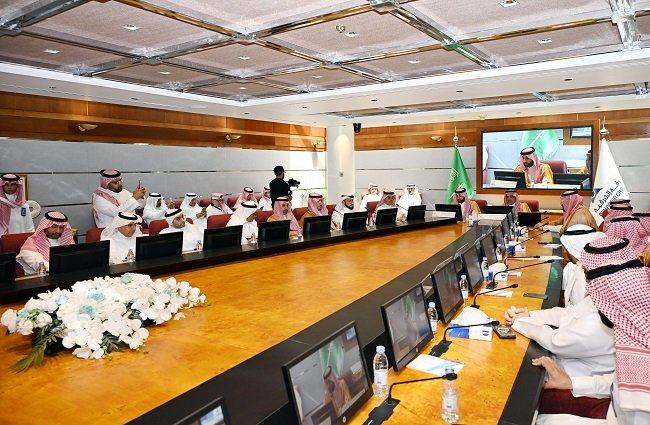
Asharqia Chamber organized on Wednesday, April 8, 2026, a meeting between the Deputy Minister of Industry and Mineral Resources for Industry Affairs, His Excellency Eng. Khalil bin Ibrahim bin Salamah, and industrialists, in the presence of Chairman of the Chamber’s Board of Directors Fahad bin Abdullah Al-Farraj, Board members Ibrahim bin Mohammed Al Al-Sheikh, Hamad bin Mohammed Al-Raqeeb, Abdulrahman bin Khalid Al-Zamil, Abdulrahman bin Mohammed Al-Bassam, and Ali bin Abdullah Al-Saihati, the Chamber’s Secretary-General Abdulrahman bin Abdullah Al-Wabel, a number of Ministry officials and members of the Kingdom’s industrial system, and businessmen, businesswomen, specialists, and male and female investors in the industrial sector in the Eastern Province. The meeting aimed to review the state’s key efforts, may Allah protect it, to support the sector amid the current challenges, and to enhance means of integration among the relevant authorities.
During the meeting, which saw a notable attendance, His Excellency Eng. bin Salamah affirmed the importance of continued communication between the public and private sectors, in a way that enhances the resilience of the industrial sector and the sustainability of its business. He also reviewed the efforts of the industry and mineral resources system, noting that the Ministry is working closely with its counterparts in the Gulf Cooperation Council countries to overcome the challenges facing industrialists from various parties, in addition to supporting factories through the Advanced Manufacturing and Production Center, particularly in providing solutions for manufacturing spare parts locally when needed.
The Deputy Minister of Industry and Mineral Resources for Industry Affairs pointed to a package of financial and financing incentives and high-quality services to support companies affected by rising costs, in addition to enhancing effective communication with the relevant authorities, including the Industrial Center and the Food Security Authority, to address challenges related to supply chains, whether in inventory or transport operations. He affirmed that the capacity of the Kingdom’s Red Sea ports has been raised to 18.6 million containers, that priority has been given to food and pharmaceutical sector shipments, and that customs procedures have been facilitated by providing 3 additional mobile X-ray units at Jeddah Islamic Port and adding 8 new entry and exit lanes at the port, and another at King Abdullah Port, enhancing the speed of the flow of imports.
The meeting also addressed the efforts of the competent authorities to raise the efficiency of the transport sector, by improving the use of trucks and applying flexible regulations for their movement within cities, in addition to exceptionally extending their operational life to 22 years, in support of the continuity of supply chains, based on the directives of the wise leadership, may Allah protect it, and its keenness to support the sustainability of economic activities by enhancing the readiness of supply chains, providing energy, and supporting the workforce, in a way that strengthens the resilience of the national economy.
The meeting stressed the importance of investors communicating with the competent authorities through the approved channels to register the challenges they face, ensuring they are addressed quickly, and called for enhanced coordination and integration among the various authorities to support the growth of the industrial sector and achieve the goals of sustainable development
For his part, Chairman of Asharqia Chamber’s Board of Directors Fahad bin Abdullah Al-Farraj explained that the industrial sector, with its effective role in the process of economic balance, represents a fundamental pillar in supporting our national choices of diversifying the sources of the national economy and reaching our goals in sustainable development. We have clearly witnessed the extent of the high-quality successes that have strengthened our country’s position among the most competitive economies globally, through the expansion of the construction of industrial complexes linked directly to scientific research centers, which has brought about a radical transformation in the pace of growth and the structure of national industry.
Al-Farraj said that the figures translate this transformation: the number of industrial establishments jumped to 12,946 by the end of 2025, with the Eastern Province ranking second in the Kingdom with 2,939 factories, confirming its role as a fundamental pillar on the industrial map. There is no doubt that the tireless efforts led by our wise government since the launch of Vision 2030 to empower national industry are clearly embodied in many major initiatives, perhaps most notably the inauguration by His Royal Highness Crown Prince Mohammed bin Salman, may Allah protect him, of King Salman Energy Park, and what this city represents as a qualitative leap in attracting investment and ensuring the efficiency of supply chains, heralding a new phase based on diversifying the industrial base and strengthening the Kingdom’s logistical reliability.
Al-Farraj explained that, as an extension of these efforts, and in recognition by Asharqia Chamber that logistical challenges and maintaining market share are a constant concern for exporters, the Chamber launched the “Logistics Database” initiative, with the aim of accelerating trade exchange by connecting exporters and importers through an organized and highly reliable network.